Real estate is more competitive than ever. Buyers expect transparency, speed, customization, and long-term value from every property. Developers want fewer delays, investors want reduced risk, and owners want assets that perform efficiently for decades. To meet all these demands at once, traditional approaches are no longer enough.
That’s where BIM (Building Information Modeling) companies step in. BIM isn’t just 3D modeling—it’s a powerful digital ecosystem that connects design, construction, maintenance, and operations into one smart, data-driven process. When real estate companies partner with BIM professionals, they gain an edge in planning, accuracy, collaboration, sustainability, and long-term profitability.
In today’s market, the real estate firms leveraging BIM are the ones closing deals faster, reducing risk, improving project outcomes, and delivering next-level experiences to clients. Let’s explore why this partnership is becoming essential—and how it transforms the entire real estate lifecycle. 🚀
The Power of Visualization: Better Decisions, Faster Sales
In real estate, visuals sell. BIM allows stakeholders to interact with highly accurate 3D models before a single brick is laid. Instead of flat blueprints, clients can take digital walkthroughs, explore interior layouts, and visualize lighting, materials, and finishes. This helps buyers make faster decisions and prevents costly revisions later. According to the National Association of Realtors, visual tools and virtual tours dramatically increase engagement and listings performance in today’s digital-first real estate market (https://www.nar.realtor/research-and-statistics).
When real estate companies partner with BIM firms, they can present properties with cinematic quality—long before the building is complete. This means sales teams can pre-sell units, secure investors, and build excitement ahead of construction. In competitive markets, that’s a game-changer. 🔑
Eliminating Guesswork: Precision Planning and Reduced Risk
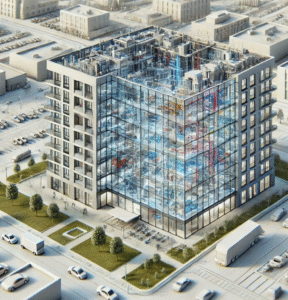
Traditional project planning often leaves room for error, which translates directly into delays and budget overruns. BIM eliminates guesswork by creating a highly detailed digital twin of the building. Every wall, pipe, wire, structure, and system is represented and analyzed in advance.
This allows teams to detect clashes early—before construction begins—saving time, resources, and reputation. Real estate companies that use BIM have a stronger command of timelines, budgets, and outcomes. They can also produce more accurate bids and feasibility studies, giving investors confidence and reducing financial risk.
Major real estate markets increasingly expect digital project coordination. In fact, many large-scale developments now require BIM for permits and collaboration. Partnering with a BIM company ensures you stay compliant, efficient, and profitable. 📊
Collaboration Made Easy: One Source of Truth for All Stakeholders
One of the biggest challenges in real estate projects is coordinating multiple parties—developers, architects, engineers, contractors, investors, leasing teams, and property managers. Without a unified system, miscommunication leads to mistakes, duplication, and delays.
BIM solves this problem by serving as a single source of truth. Everyone accesses the same live model in real time, simplifying revisions and ensuring that decisions are based on accurate information. Updates made by one stakeholder are visible to all, eliminating alignment issues.
This level of collaboration accelerates decision-making and keeps everyone accountable. According to Real Estate Weekly, technology-led collaboration tools like BIM are directly linked to higher project performance and improved profitability in development projects (https://rew-online.com/). 🤝
Cost Savings at Every Stage: From Construction to Operations
Real estate companies don’t just care about design—they care about the bottom line. BIM companies deliver major cost savings across the entire lifecycle of a building.
During construction, BIM eliminates change orders and waste. But the real magic happens after the project is complete. Because BIM creates a digital twin, facility managers can track equipment performance, schedule maintenance, and avoid expensive failures. Owners can optimize energy use, extend asset life, and simplify renovations.
According to a case study on Wikipedia about Building Information Modeling (https://en.wikipedia.org/wiki/Building_information_modeling), BIM-driven facilities management significantly reduces operational costs over time. When you consider that building operations account for 70% of its total cost over its lifetime, BIM isn’t just smart—it’s essential. 💡
Higher Property Value: Smart Buildings Attract Smart Buyers
Modern buyers and tenants aren’t just looking for space—they want technology, efficiency, and sustainability. BIM allows real estate companies to design smart buildings with integrated systems for HVAC, lighting, security, and more. Designers can simulate energy usage, daylight exposure, and material performance to achieve better green certifications.
Results? Lower utility costs, happier tenants, and dramatically higher resale value. In a sustainability-focused market, BIM gives real estate companies the tools to stay ahead of regulations and stay attractive to investors. 🌿
Faster Approvals and Compliance with Local Regulations
Navigating zoning laws, building codes, and government approvals can slow real estate projects to a crawl. BIM companies help streamline the process with digital documentation and code-compliant models.
Many municipalities now support BIM-based submission, allowing faster reviews and fewer revisions. Real estate companies that embrace BIM move through planning departments with ease, staying ahead of slower competitors.
Industry reports like those from Commercial Observer highlight how developers using technology-based compliance tools experience faster permitting and fewer legal setbacks (https://commercialobserver.com/). ⏱️
Marketing Advantage: Stand Out in a Crowded Market
Marketing a property is easier when you can show instead of tell. BIM makes this possible with high-quality 3D renders, virtual tours, animations, and immersive experiences. These assets can be used in listings, brochures, social media, and investor presentations.
Buyers no longer settle for generic renderings. They want depth, context, and emotional connection to the space. Real estate companies partnering with BIM firms can deliver cinematic previews that build excitement and win deals before construction even begins. 📣
Flexibility for Future Growth: Buildings Designed to Evolve
Real estate isn’t static—properties evolve. Tenants move in and out, floor plans change, expansions happen, renovations are required. Without proper documentation, these updates become expensive and risky.
BIM preserves a complete digital record of the building. Future architects or contractors can make changes with full knowledge of existing layouts, materials, and systems. This saves time, reduces surprises, and ensures structural integrity. BIM makes buildings adaptable—and adaptability equals long-term value. 🔄
Investors Love Predictability—and BIM Delivers
Investors are more likely to back projects that are well-planned, transparent, and data-driven. BIM helps real estate companies produce reliable cost estimates, construction schedules, and performance forecasts. This improves trust and speeds up capital approval.
In today’s real estate economy, institutional investors are prioritizing technology-enabled developments that minimize risk and support sustainability. By partnering with BIM companies, real estate developers signal that they are forward-thinking, disciplined, and ready for growth. 💼
Competitive Advantage: The Future of Real Estate Is Digital
The real estate industry is undergoing a major digital transformation. Those who embrace innovation are rising to the top—those who resist are being left behind. BIM adoption is rapidly increasing across commercial, residential, and mixed-use developments worldwide.
Real estate companies that align with BIM firms can:
✔ Reduce delays and budget overruns
✔ Improve buyer confidence
✔ Produce smarter, more efficient buildings
✔ Streamline construction and operations
✔ Increase long-term profitability
In short, BIM isn’t just a tool—it’s a strategic partnership that unlocks greater success at every stage of the real estate journey. 🧠
Conclusion: Partnering with BIM Is No Longer Optional—It’s a Competitive Necessity
Real estate companies face new challenges, higher expectations, and tighter margins. To thrive in this environment, they need innovation, precision, and collaboration. BIM companies provide exactly that.
Whether it’s visualizing properties before construction, avoiding costly mistakes, simplifying approvals, increasing sustainability, or boosting profitability, the benefits of BIM are undeniable. Projects become smoother. Buyers become more confident. Buildings perform better. And real estate businesses grow stronger.
The future of real estate belongs to those who build smarter. Partnering with BIM companies is not just a competitive advantage—it’s the new standard for excellence in the industry. 🏗️🔥
Real estate and BIM together don’t just build buildings—they build success.